Giardia lamblia | Parasitology
The protozoon was initially named Cercomonas intestinales by Lambla in 1859. and renamed Giardia lamblia by Stiles. is exists forms Trophozoite, Cyst.

Giardia lamblia | Parasitology
The protozoon was initially named Cercomonas intestinales by Lambla in 1859. and renamed Giardia lamblia by Stiles.
Geographical Distribution: It is worldwide in distribution and is the most protozoan isolated from human stools
Habitat - It is a protozoan parasite that colonizes the upper portions of the small intestine, Giardia no- invasive and quite often results in asymptomatic infections. Morphology Giardia exists in two forms
Forms of giardia lamblia
Trophozoite
Cyst
 |
| Morphology Giardia exists trophozoite, Cyst forms T |
Trophozoites
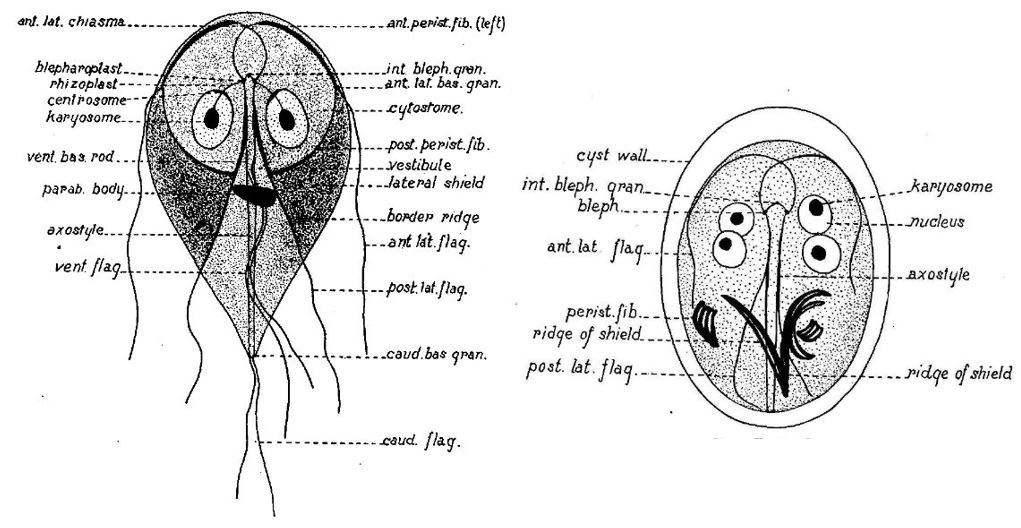
- Giardia trophozoite exhibits a Characteristic pear Shape or that of a tennis badminton racket.
- It has a rounded anterior and pointed posterior end.
- It is 12-15 Um wide and 2-4 um thick.
- The dorsal surface is Convex and for ventral Surface is Concave with a Sucking disc.
- There are two axostyles, two nuclei, and four pairs of flagella
- The nuclei are rounded midline placed one on each side of the midline
- Each nucleus possesses a large central Karysome.
- There is a lack of chromatin which gives the nuclei a halo appearance.
- The median bodies are a pair of curved red- Shaped structures. Which lies posterior to nuclei
- These are involved with adhesive disc and its formation.
- The trophozoite exhibits distinctive erratic twisting motion
- It absorbs nutrients from the intestinal lumen via Pinocytosis.
- The trophozoite stage is also lumen via characterized by an asexual replication.
- Bath nuclei divide at about the same time and cytokinesis restores the binucleated State.
Cyst
- As an alternative to replication, the trophozoite can encyst.
- during encystment, the parasite rounds up, detaches from the intestinal epithelium, and Secreter a cyst wall.
- After cyst wall formation the parasite undergoes one round & nuclear without cytokinesis resulting in the division in four nuclei.
- The cyst is oval-shaped and typically. measure 11-14μm in length and 6-10 um wide.
Life cycle of giardia lamblia
- Giardia completes its life cycle in a Single host e.g. man
- 2 Cyst are the infective stage of the parasite.
- Infection occurs by ingestion of cysts in contaminated water, food by the fecal-oral route.
- From each cyst, two trophozoites are released.
- Trophozoites multiply by longitudinal binary fission remaining in the lumen of the proximal part of the duodenum or upper part of the jejunum.
 |
| Giardia lamblia life cycle |
Pathogenicity
- The pathological condition caused by Giardia is known As giardiasis.
- The incubation period is of 1-8 weeks.
- This interferes with the absorption of nutrients, especially fats
- When a parasite localizes in the biliary tract, it -may have chronic cholecystitis and jaundice
Clinical diagnosis and Symptoms
- The first signs of acute giardiasis include nausea, apathy. headache, loss of appetite, and an upper gastrointestinal uneasiness.
- Children exhibit Clinical symptoms more frequently than adults.
- Acute infections can also develop into long-standing subacute
- Severe Giardia lamblia infection can result in partial villi lactase deficiency is seen and may persist.
Laboratory diagnoses
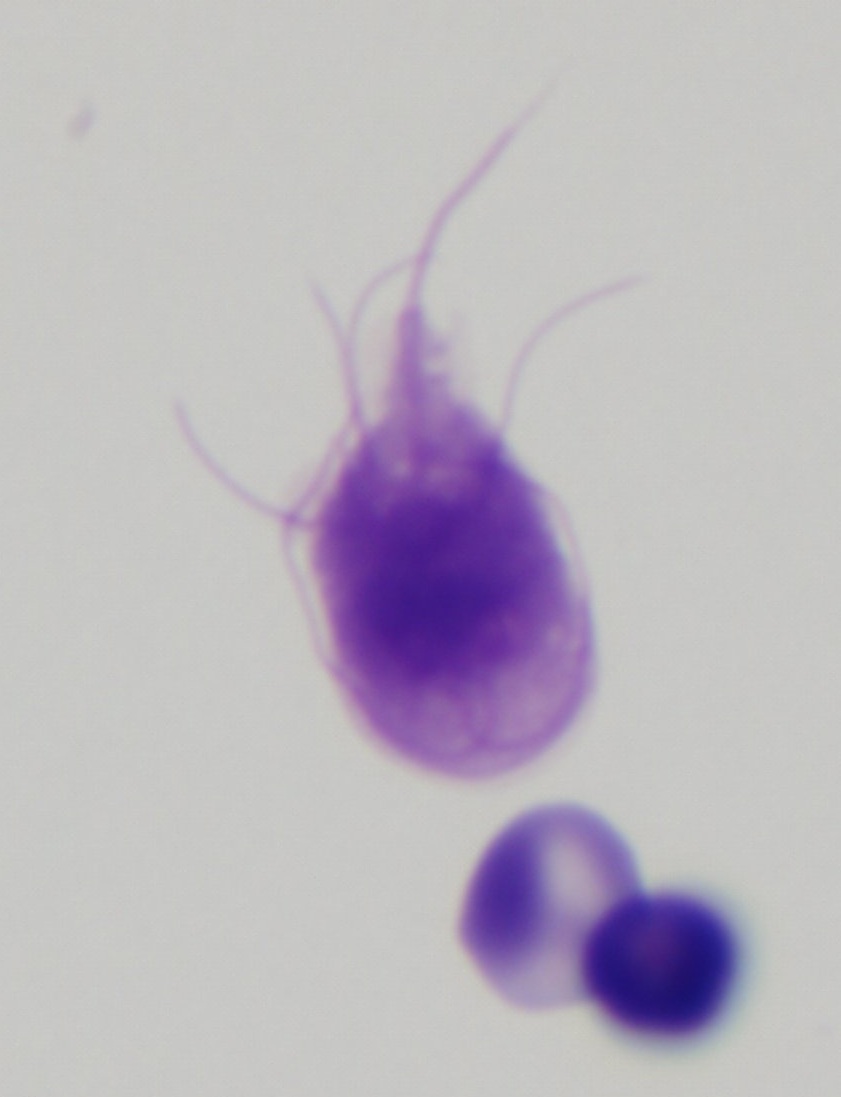
Microscopic examination of Stool - demonstration of Giardia trophozoite. and cyst in freshly passed the stood by warped preparation (Saline. and iodine) is useful for diagnoses...
 |
| Laboratory diagnoses of Giardia lamblia |